

LG-N24V15Ah
Built with an 8S1P sodium-ion cell configuration, this battery combines low-temperature performance, high safety and long cycle life for mobility and other power applications.
View specifications ↓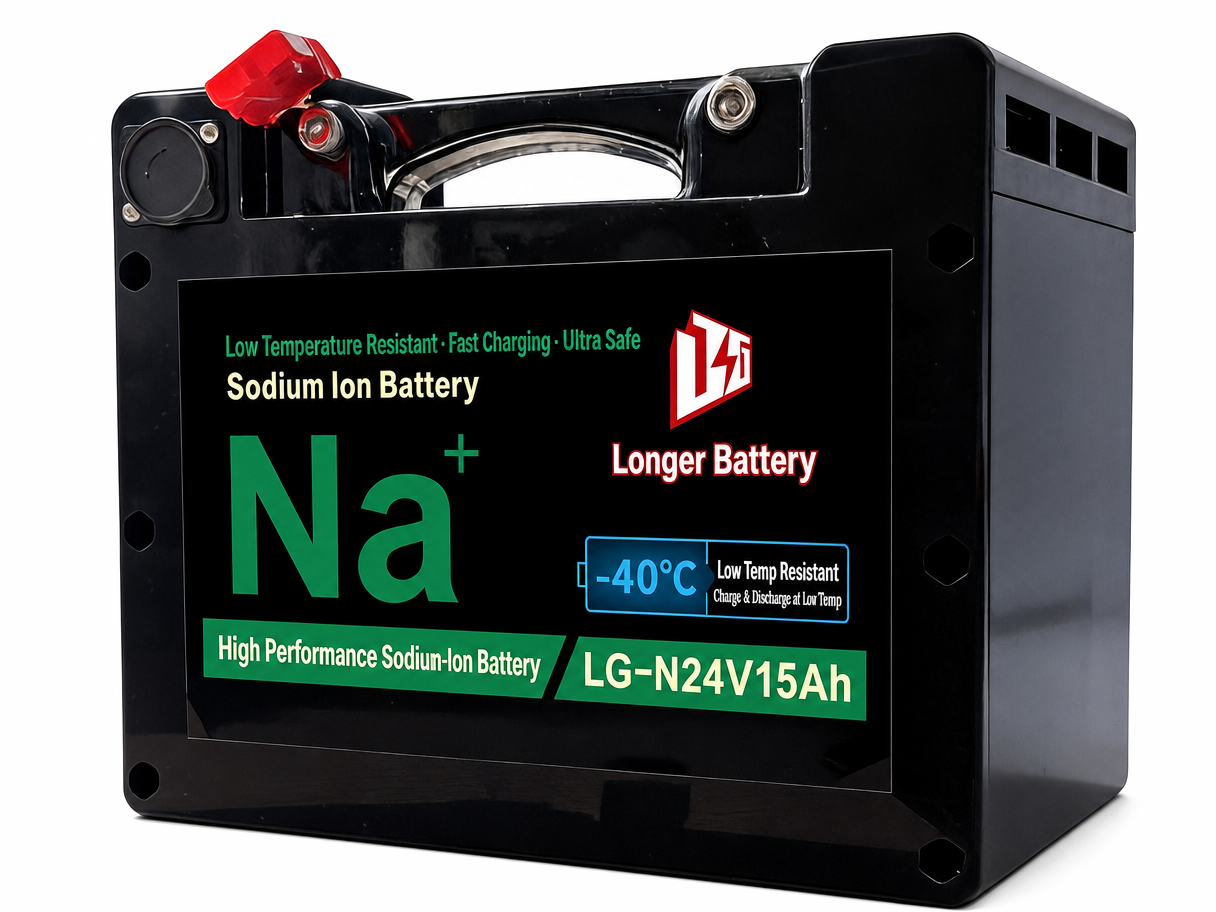
Key data at a glance
Explore the key specifications below. Contact our team to discuss your application and configuration.
Specifications
- Product model
- LG-N24V15Ah
- Battery chemistry
- Sodium-ion battery
- Configuration
- 8S1P
- Nominal voltage
- 24 V
- Nominal capacity
- 15 Ah
- Nominal energy
- 360 Wh
- Operating current
- 15 A
- Maximum operating current
- 30 A (45 A instantaneous for 5 s)
- Charging current
- 7.5 A
- Maximum charging current
- 15 A
- Charging voltage
- 29.2 V
- Discharge cut-off voltage
- 12.0 V
- Charge / discharge ports
- Discharge: 40 A Anderson; charge: 3-pin XLR
- Communication protocol
- None
- Operating temperature
- Charge / discharge: -40°C to +60°C
- Dimensions
- 220 × 160 × 220 mm
- Weight
- 4.3 ± 0.3 kg
- Housing material
- V-0 flame-retardant plastic
- Cycle life
- ≥ 2,000 cycles (25°C, 0.2C charge / 1C discharge)
Technical Overview
Quick answer: The LG-N24V15Ah is a 24 V / 15 Ah (360 Wh) sodium-ion battery pack with an integrated BMS, engineered for mobility applications. Built on an 8S1P configuration of Na-15Ah cells, it delivers 30 A maximum discharge current (45 A peak for 5 s), operates from −40 °C to +60 °C, offers ≥2,000 cycles, and weighs just 4.3 kg—combining low-temperature resilience with high safety.
What Is the LG-N24V15Ah Sodium-ion Battery?
The LG-N24V15Ah, model LG-N24V15Ah from Kunlu, is a low-temperature-resistant, high-safety sodium-ion battery pack with an integrated battery management system (BMS), designed for mobility applications such as light electric vehicles and equipment that must work through cold winters. Where lithium-ion packs lose most of their usable capacity below freezing, this sodium-ion pack charges and discharges across a −40 °C to +60 °C window.
Key Technical Specifications
| Parameter | Value |
|---|---|
| Nominal voltage / capacity | 24 V / 15 Ah (360 Wh), 8S1P |
| Cell model | Na-15Ah sodium-ion |
| Operating current | 15 A continuous |
| Max discharge current | 30 A (instantaneous 45 A @ 5 s) |
| Charge current | 7.5 A standard / 15 A maximum |
| Charge voltage / cut-off | 29.2 V / 12.0 V |
| Operating temperature | −40 °C to +60 °C (charge and discharge) |
| Cycle life | ≥ 2,000 cycles (0.2C charge / 1C discharge @ 25 °C) |
| Interfaces | Discharge: 40 A Anderson · Charge: 3-pin XLR |
| Dimensions / weight | 220 × 160 × 220 mm / 4.3 ± 0.3 kg |
How Is the Pack Constructed?
The pack houses its 8S1P cell array in a dedicated V-0 flame-retardant plastic enclosure. Molded support brackets and pure nickel strips form the module structure, with the main positive and negative paths routed through AWG 12# power cabling to the P+ terminal, BMS, and output interface. All module sides are wrapped in 1.0–1.5 mm epoxy resin board for complete electrical insulation.
What Does the Integrated BMS Protect Against?
The built-in BMS provides multi-layer, settable protection:
- Overcharge: cell-level cutoff at 3,650 mV (release 3,500 mV) and pack-level at 29.2 V (release 28.0 V), both with 1,000 ms delays
- Overdischarge: cell-level cutoff at 1,500 mV (release 1,600 mV) and pack-level at 12.0 V (release 12.8 V)
- Overcurrent: charge cutoff 60 A; two-stage discharge cutoffs at 30 A (3,000 ms) and 45 A (40 ms)
- Short circuit: protection engages in 320 μs (100–800 μs range)
- Temperature: charge blocked outside −10 °C to +55 °C; discharge blocked outside −20 °C to +75 °C; MOSFET cutoff at 90 °C
The BMS itself draws only 5.7 mA operating (113 μA asleep), keeps charge/discharge loop resistance at 4 mΩ, and limits MOSFET temperature rise to 20 °C after one hour of 20 A continuous discharge without a heatsink.
Why Choose Sodium-ion for Cold Climates?
Sodium-ion chemistry tolerates charging at temperatures where lithium-ion packs must be heated or blocked. With a −40 °C discharge floor, ≥2,000-cycle life, and thermal-runaway-resistant chemistry in a V-0 rated housing, the pack suits outdoor mobility fleets, winter logistics, and backup applications where reliability matters more than peak energy density.
FAQ
What connectors does it use? A 40 A Anderson connector for discharge and a 3-pin XLR (1: +, 2: −, 3: GND) for charging.
Does it support communication protocols? No—this version ships without a communication interface; all BMS thresholds are factory-settable.
How should testing be handled safely? Always disconnect the load before short-circuit or overcurrent verification; short-circuit current can reach thousands of amperes.